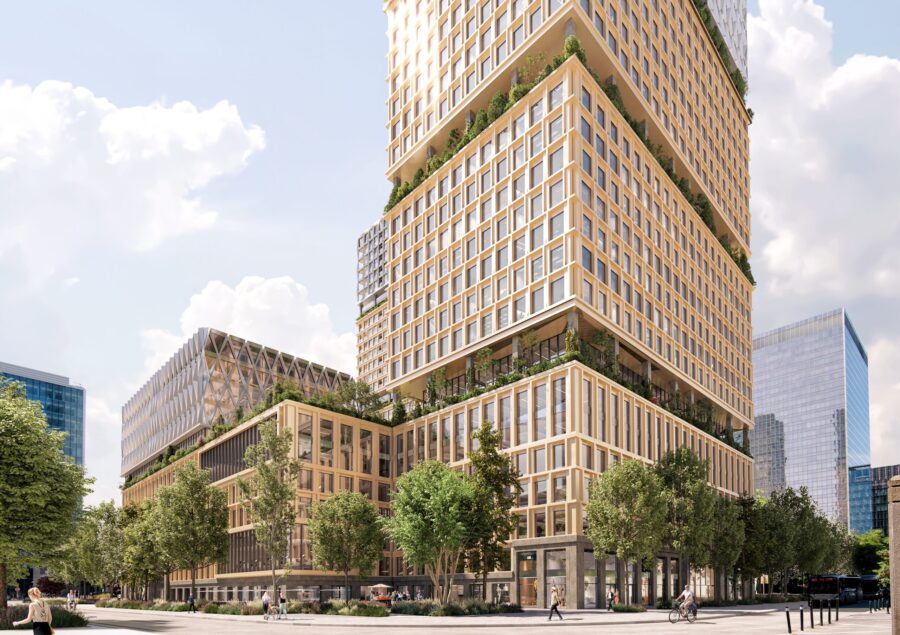
Bel Towers – Adaptive Reuse of an Office District
Transforming Brussels’ North District into a Mixed-use Urban Neighbourhood
Bel Towers transforms one of Brussels’ most recognisable office complexes into a vibrant mixed-use urban neighbourhood. Located in the heart of the Brussels North District, the project reimagines the former Belgacom Towers as an integrated urban destination where living, working, learning and recreation come together.
Rather than replacing the existing buildings, the project demonstrates how adaptive reuse can unlock the potential of the contemporary city. By building upon the value already embedded within the existing structures, Bel Towers significantly reduces material consumption, preserves embodied carbon and extends the lifespan of the towers while preparing them for future generations.
The redevelopment forms part of the Brussels Region’s broader ambition to transform the North District from a monofunctional business area into a lively and inclusive neighbourhood that remains active throughout the day and evening.
A New Urban Community
With a programme of approximately 122,700 m², Bel Towers brings together premium office space, affordable housing, student accommodation, education, retail, restaurants, coworking, fitness facilities and public amenities within a single coherent urban ensemble.
The project creates a genuine mixed-use neighbourhood where residents, office workers, students and visitors share public spaces, green areas and collective facilities. Active ground floors reconnect the site with the surrounding streets, while a generous public square and carefully designed pedestrian routes strengthen the relationship between the towers and the city.
A defining feature of the project is the sequence of Sky Gardens and rooftop landscapes that extend community life vertically through the towers. These collective outdoor spaces provide places for relaxation, interaction and wellbeing while contributing to urban biodiversity and offering panoramic views across Brussels.
Adaptive Reuse as the Foundation for Sustainability
Bel Towers demonstrates how adaptive reuse has become one of the most effective strategies for sustainable urban development.
Approximately 75% of the existing structure is retained, substantially reducing demolition waste, material consumption and embodied carbon. Rather than treating sustainability as a technical add-on, the project begins with preserving and transforming what already exists.
The architectural intervention combines the robust concrete structure of the existing towers with contemporary additions designed for flexibility and future adaptability. This approach ensures that the buildings can continue to evolve as urban needs change over time.
Timber Construction and Low-carbon Design
The new façade elements are constructed in Cross-Laminated Timber (CLT), a renewable bio-based material that significantly lowers the project’s embodied carbon footprint while providing a warm and contemporary architectural expression.
A comprehensive sustainability strategy combines timber construction with geothermal energy, heat pumps, rainwater harvesting and more than one hectare of landscaped public spaces, roof gardens and ecological habitats that enhance biodiversity throughout the development.
Architecture Connected to the City
Bel Towers is designed as an open urban destination rather than an isolated office complex. The former barrier between the buildings and the public realm is replaced by a welcoming sequence of squares, streets, gardens and active plinths containing cafés, shops and public functions.
The project reconnects the towers with Brussels through generous public spaces, improved pedestrian accessibility and strong connections to Brussels North Station, encouraging sustainable mobility and reinforcing the ambitions of the 15-minute city.
By combining adaptive reuse, mixed-use programming, timber construction, biodiversity and high-quality public space, Bel Towers illustrates how existing office districts can become resilient urban neighbourhoods. The project demonstrates that the future of city-making lies not only in building new places, but in transforming the city that already exists.